"Can ChatGPT plan my delivery route?" is a real question, typed into a real chat window, usually somewhere around stop nine of a fifteen-stop day. It's a reasonable thing to try. The chat app is already open, the addresses are already in your hand, and pasting a list feels faster than downloading something new.
Here's what actually happens when you try it, why it happens, and where an AI model is genuinely useful for this job instead.
What actually happens when you paste your stops in
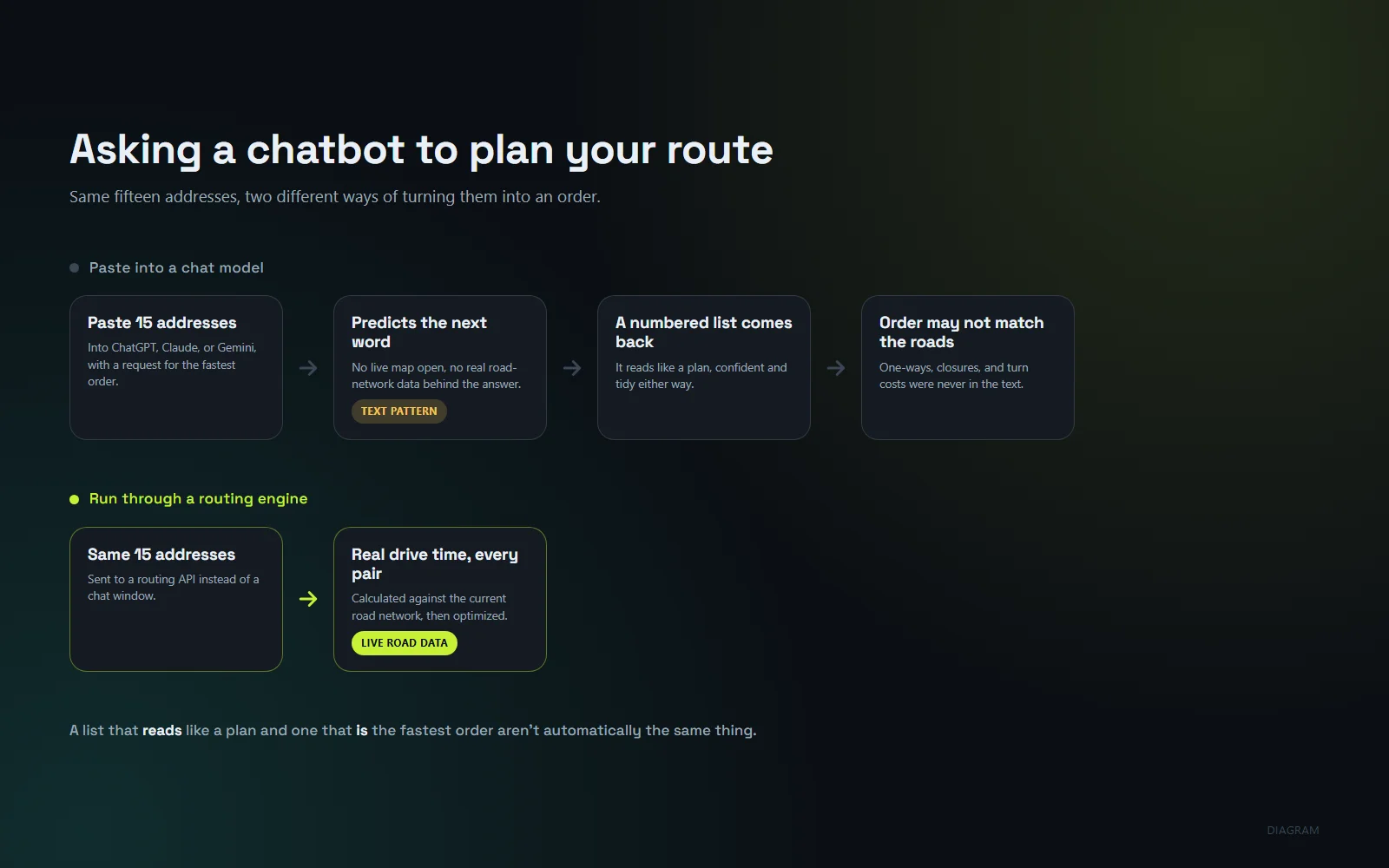
Paste ten or fifteen addresses into ChatGPT, Claude, or Gemini and ask for the fastest order, and you'll get an answer. It reads like a plan: a numbered list, maybe a line about grouping stops that are close together. That confidence is the problem. Not the list. It sounds like a plan whether the order underneath it is good or not.
A chat model doesn't have a live map open while it's answering you. It's predicting the next most plausible word based on everything it's seen written about addresses, cities, and how driving directions usually get described. It can notice that two addresses share a street name, or that two postal codes look close on paper. It has no way to know that the street between them is one-way, that the bridge connecting two "close" points is closed for repaving, or that turning left across four lanes of traffic at 5 p.m. costs six real minutes every time you do it on that route. None of that lives in the text you pasted in.
Why a chat model can't solve this the way a routing engine does
Real route optimization needs two things a chat model doesn't have on its own: live road-network data, and an algorithm built to solve an ordering problem, not a writing problem. That's genuinely different software, the same reason mapping companies run dedicated routing APIs instead of asking a language model to describe the fastest way somewhere.
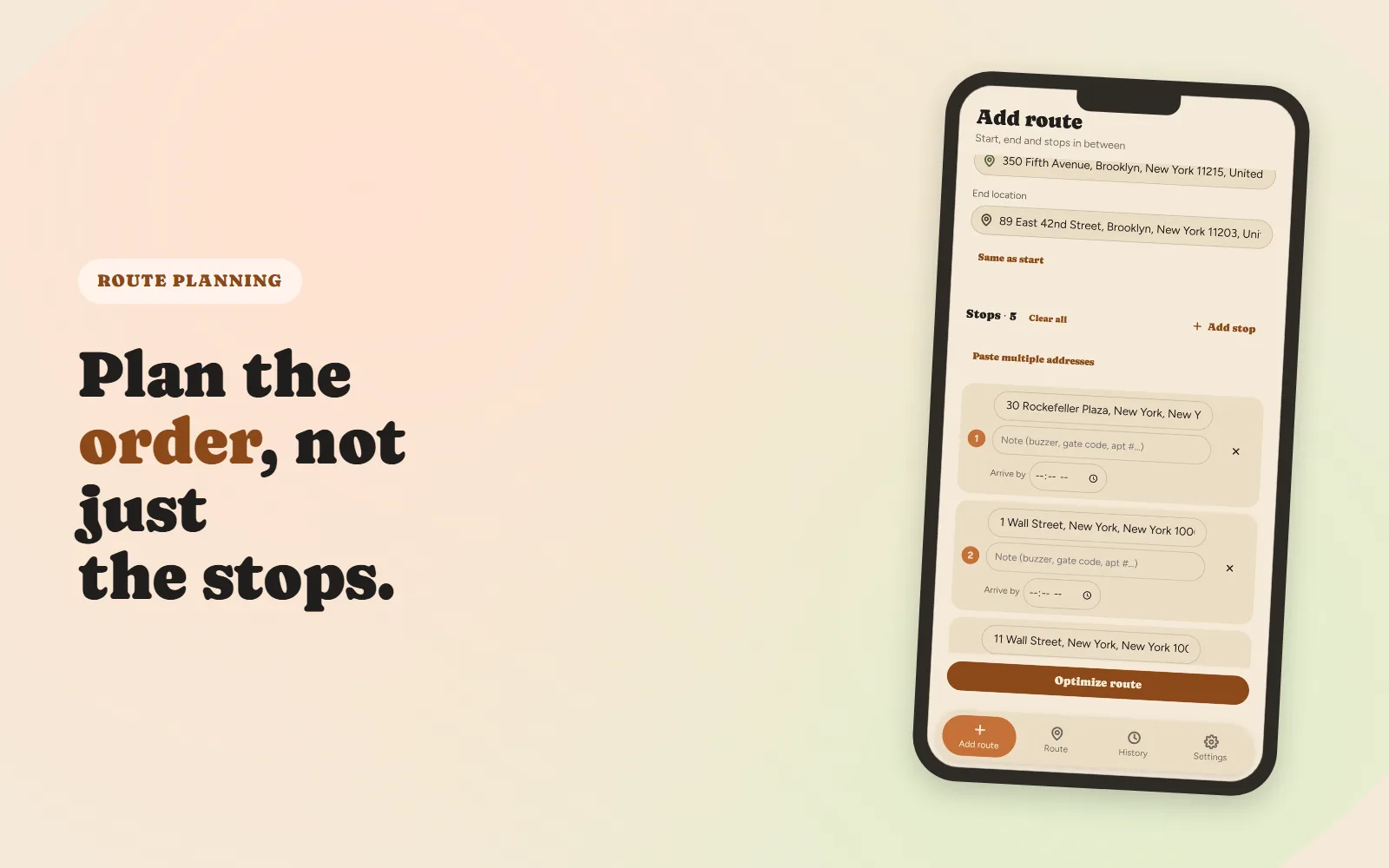
Fix My Route doesn't ask an AI to plan the route either, for the same reason. Stops go to Mapbox's Directions and Matrix APIs, which return real drive times between every pair of points based on the current road network, then a clustering and optimization step turns that into an actual visiting order. That's a calculation against real map data, not a written answer to a question. The distinction matters more than which specific product you use. A planner worth trusting runs real road data through an optimizer somewhere. Not a model guessing.
The one part of this job AI models are genuinely good at
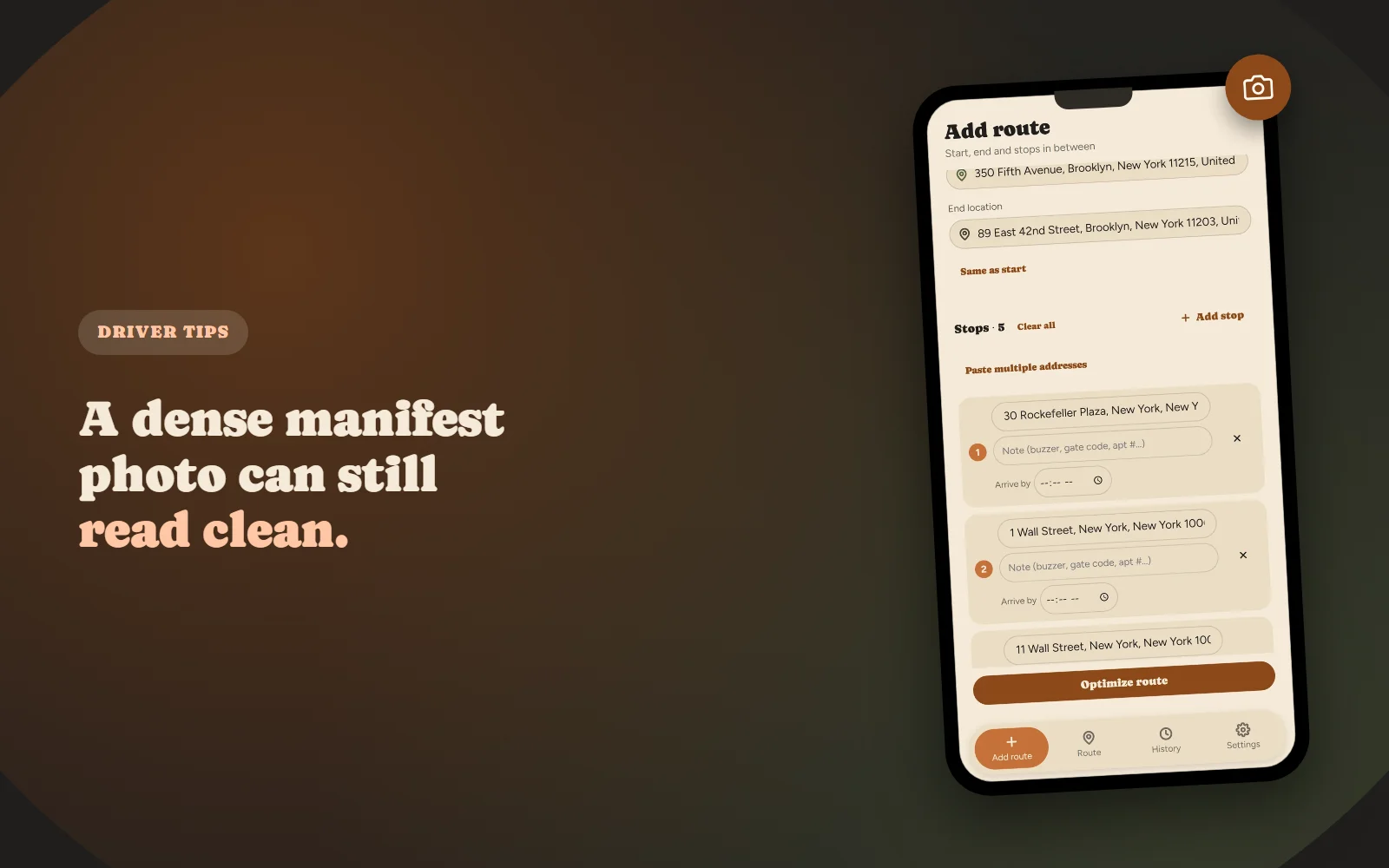
There's a narrower job AI models are good at here: reading text out of an image. A photo of a delivery manifest, or a screenshot from a dispatch app, handed to a vision model is a text-extraction task, which is exactly what those models are built for. Fix My Route uses Claude's vision model for that one step, reading the manifest and pulling the addresses out of it, then handing those addresses to the actual routing engine to get sequenced. Reading a list and planning a route are two different problems, worth keeping separate even when the same app handles both.
When asking an AI for a quick order is genuinely fine
None of this means asking a chatbot is always the wrong move. Four or five stops on streets you already drive, where you're mostly just deciding whether two nearby stops are worth doing back to back, and a quick sanity check from a chat model costs nothing. You know the roads well enough to catch it if the answer is obviously off.
The failure mode grows with the stop count and shrinks with how well you know the area. Ten-plus stops, a part of town you don't drive every week, a route where one wrong pairing costs real minutes you won't notice until you're already past the turn. That's the point where "reads like a plan" and "is actually the fastest order" stop being the same thing, and where it's worth checking the suggested order against real drive times before you commit a whole shift to it.

Fix My Route Team
We build route-optimization software for delivery drivers and couriers, and write about the planning and engineering problems that come up running real multi-stop days.
Keep reading
Why Your Manifest Photo Import Comes Back With Missing Addresses
The three specific reasons a photo import comes back light on addresses, and how to get a clean read on the first try.
How to Plan a Multi-Stop Delivery Route (Without Losing Half Your Day)
A practical, step-by-step approach to sequencing ten-plus stops.