Most route planner comparisons list features and declare a winner. That tells a driver very little about what happens on an actual shift, with real stops and real traffic.
So we measured one. The same 17 real delivery stops were planned in Fix My Route and in Zeo Route Planner, and both visiting orders were run through the same road data. We build Fix My Route, so treat this as our test, with the method laid out so you can judge it for yourself.
The short version: neither app won outright. One order was faster and the other was shorter, and the difference between those two words is the useful part.
The test
The route was a real shift for a local delivery business in the Toronto area: 17 deliveries, starting and ending at the same depot in Mississauga. The stops were spread across Etobicoke and west Toronto, including Long Branch, the Humber Bay Shores condo towers, Mimico, The Queensway, High Park and Bloor West, Islington and The West Mall.
The driver planned the stops in both apps and exported Zeo's planned route. Three things keep the comparison fair:
- Same road data for both orders. Each visiting order was routed through Mapbox, so the only thing that differs is the order the stops were visited in.
- Same traffic for both. Drive times use Mapbox's predicted traffic for a weekday at 2:05 PM, when the route was planned. They are not Zeo's own estimates, and not the live ones Fix My Route shows either.
- Same allowance at each door. Totals add 2 minutes per delivery to both orders.
One more check: Zeo's export reports 69.9 km for its order, and routed through Mapbox it also came to exactly 69.9 km. The two road datasets agree, so the gaps below aren't an artifact of the map.
This is one route. It can't show that either app is faster or shorter in general.
The results
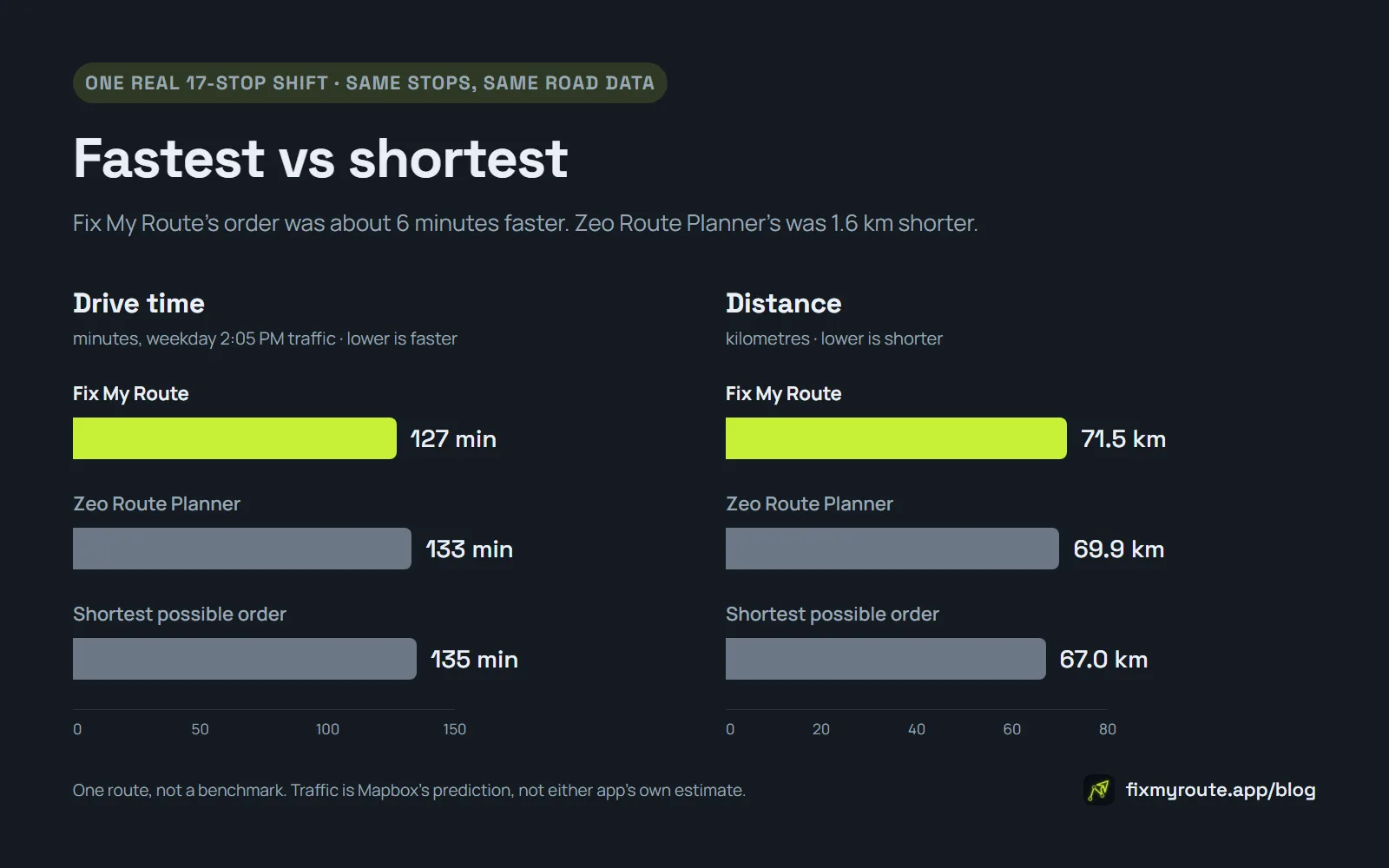
- Fix My Route: 71.5 km, 127 minutes of driving in traffic, 2 h 41 m including stops.
- Zeo Route Planner: 69.9 km, 133 minutes of driving, 2 h 47 m including stops.
- Shortest possible order (planned for distance alone): 67.0 km, 135 minutes of driving, 2 h 49 m including stops.
Fix My Route's order was about 6 minutes faster. Zeo's order was 1.6 km shorter. Both are true at once.
The third line is the one most drivers never see. The shortest order possible saved 4.5 km against Fix My Route's and took 8 minutes longer. On this route, kilometres and minutes pulled in opposite directions, and no order won on both.
Where the two routes split
The gap came from three decisions, described here by neighbourhood rather than address:
- A stop on The Queensway near Islington. Zeo visited it second, on the way down to Long Branch. Fix My Route left it for the final loop through the same area at the end of the day.
- A stop on The Queensway near Humber Bay. Zeo visited it before heading north to the High Park stops. Fix My Route did High Park first and came back south for it afterwards. On a map that detour looks wasteful; by road it was quicker. That's the whole finding in miniature: a route that looks worse can drive better.
- The last three stops, around Islington and Dundas Street West, were visited in a different order.
Why Zeo's order came out shorter isn't visible from outside the app, so we won't guess.
What Fix My Route's optimizer did
Fix My Route plans for drive time: it looks for the fastest visiting order. It doesn't currently offer a choice between fastest and shortest, which matters for some of the drivers described further down.
We also checked whether its result was just a search that stopped too early:
- Ten times the search time changed nothing. Raising the optimizer's time from 3 seconds to 30 produced the identical order.
- There was no useful middle ground. Adding a charge of 30 seconds per kilometre to the drive time returned the same route. At 60 seconds per kilometre it returned 68.1 km and 136 minutes: shorter than Fix My Route's order, but slower than both apps' orders.
On this route the choice really was the fast order or a slower one. Nothing kept the time and captured most of the distance.
What the difference is worth
At a typical 8 L/100 km, 1.6 km is about 0.13 litres of fuel. That's well under a dollar.
Six minutes is an earlier finish, or time for another delivery. On a single shift, 6 minutes usually counts for more than 0.13 litres. Kilometres earn their weight as they add up over months of driving, and when the running costs are yours.
How to choose between fastest and shortest
Start from what your pay and costs actually depend on:
- Favour the fastest order when your time is the limit. If you're paid per stop or per shift, or you have a hard finish time, minutes are what you're trading.
- Favour the shortest order when you carry the running costs. If you pay for your own fuel, take the wear on your own vehicle, or drive a lease with a kilometre cap, distance comes straight out of your pocket.
- Be wary of the shortest possible order. On this route it saved 4.5 km and cost 8 minutes, a poor trade unless distance is the only thing you pay for.
Whichever app you use, test it on your own routes. A single shift in Etobicoke says very little about your Tuesday.
Final thoughts
On one real 17-stop shift, Fix My Route's order was about 6 minutes faster and Zeo's was 1.6 km shorter. The shortest order possible cost the most time of the three.
The takeaway is the question, not the winner. Fastest and shortest are different goals, and a good answer to one is often a worse answer to the other. Know which one your day runs on, then check your planner against it.
Zeo Route Planner is named here only to identify the product. Fix My Route is not affiliated with or endorsed by Zeo.
Fix My Route Team
We build route-optimization software for delivery drivers and couriers, and write about the planning and engineering problems that come up running real multi-stop days.
Keep reading
How to Plan a Multi-Stop Delivery Route (Without Losing Half Your Day)
A practical, step-by-step approach to sequencing ten-plus stops.
Free vs. Paid Route Planner Apps: What Actually Changes at ~$9/Month
What typically stays free, what gets capped, and a simple way to decide if the upgrade is worth it.